

1. Game Overview
Loop Hero is a roguelike RPG where you don’t control the hero directly, but instead, shape the world around them. As the hero travels a looping path through darkness, you deploy cards that place terrain, buildings, or enemies to alter their journey. You equip gear, collect resources, and upgrade a central base to break the cycle, while each loop brings tougher foes and deeper strategy.

- Developer: Four Quarters
- Publisher: Devolver Digital
- Release Date: March 4, 2021
- Platforms: Linux, macOS, Windows, Nintendo Switch, Xbox One, Xbox Series X
- Genre: Roguelike, Deck-building, Strategy, RPG elements
- Core Loop: Start Expedition → Place cards and walk loops → Fight monsters & collect loot → Return to camp → Upgrade hero and unlock cards → Start new expedition

Heads‑Up: Be cautious with Goblin Camps because a cluster of goblins can overwhelm you quickly
2. Core Facts Table and Gameplay Summary

The table below outlines Loop Hero’s core gameplay systems, what each system does, and how it affects the player’s decisions and strategy:
| System | What It Does | Player Impact |
|---|---|---|
| Cards and Tiles | Place or remove landscape, enemies, buildings; adjacency, stacking and evolution apply modifiers | Combos and removal (Oblivion) matter; synergy is key |
| Classes | Warrior, Rogue, Necromancer plus variants with traits | Choice shapes gear, playstyle, and priorities |
| Base | Spend run resources on structures, crafting, new cards, upgrades | Order of builds affects long-term options |
| Boss Meter, Trigger | Certain tile placements charge meter; when full, boss appears at loop exit | Meter timing is risk management |
| Traits (Perks) | Passive bonuses from trait choices once unlocked via camp | Traits mix with class and gear; trait deck biases choices |
| Loot and Equipment | Enemies drop gear and resources; gear modifies stats | Gear + class + trait synergy determine strength |
| Retreat and Death | Retreating saves resources; dying loses most | Retreat at camp when unsure; death is costly |
| Risk, Reward & Pacing | All systems interact to define run tension | Pushing further yields more gains but more danger |
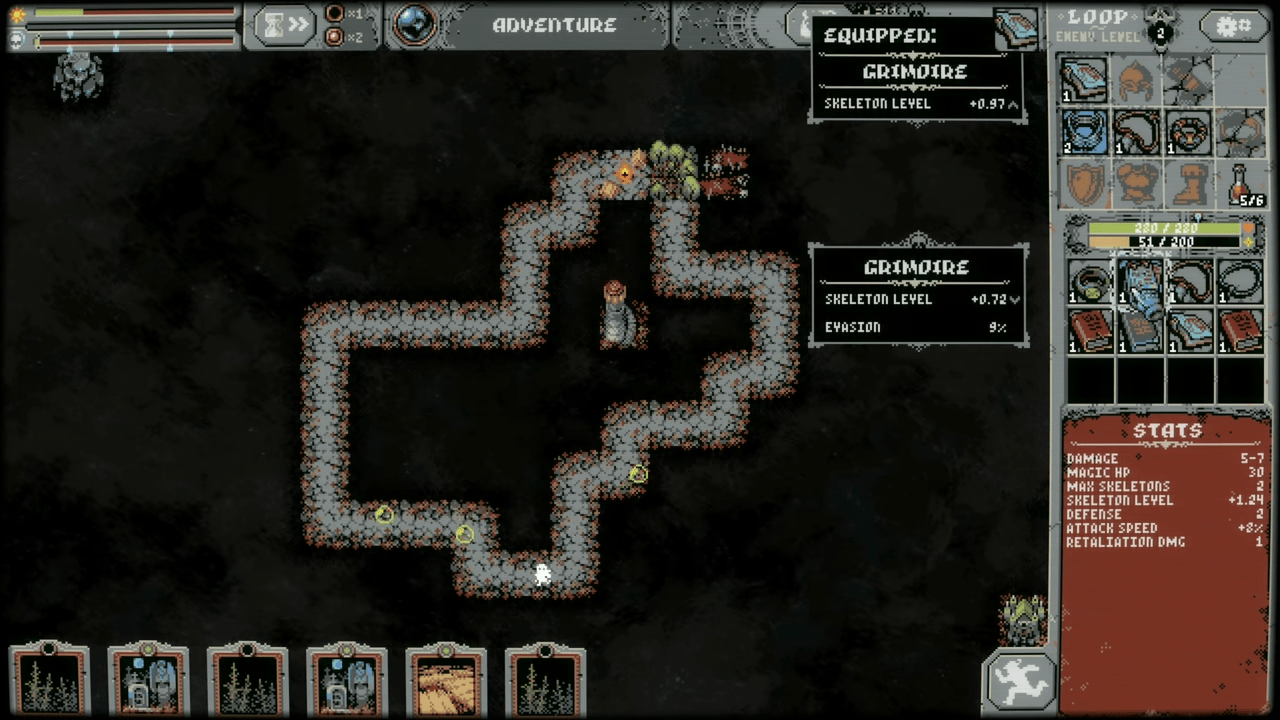
Resource Note: You don’t always want the highest level gear. Choose items that boost the stats your build needs most (crit, skeleton level, vampirism, etc.)
3. Cards, Tiles, and Map Interactions
Cards are the primary means of shaping each loop. Landscape cards (forest, meadow, mountain, etc.), road-adjacent cards (villages, groves, outposts), and building cards grant area effects, alter spawn types, and may evolve via adjacency synergies.

- Adjacency and Stacking: Placing multiple of the same or compatible tiles next to each other often upgrades their effect (for example, 3×3 rock/mountain forming a Mountain Peak gives a health bonus and spawns Harpies). Adjacency is counted in the cardinal directions (not diagonals) for many combinations (e.g. mountains)
- Enemy Spawning & Combo Effects: Some tiles automatically spawn enemies each loop or after a number of days (e.g. groves, battlefields). Card placement increases spawn frequency and loot opportunities. Certain tile combos can also produce new effects (e.g. Blooming Meadows, Blood Paths)
- Oblivion and Regulation: The Oblivion card lets you delete a tile and any creature on it, which may roll back the boss meter slightly. However, playing Oblivion still counts as placing a card (which may momentarily raise the boss bar) and can trigger the boss if the meter was nearly full. Using Oblivion strategically is crucial to managing spawn rate and boss pacing.

Practical Tip: Rivers double the effect of adjacent tiles. Use zigzag river placement to amplify tile bonuses like meadows or forests.
4. Classes, Gear, and Combat Fundamentals
Loop Hero’s three starting classes each work differently with loot and tiles. The Warrior prioritizes defense, shields, and durability; the Rogue emphasizes attack speed, criticals, and the loot-yielding mechanic; the Necromancer focuses on summoning skeletons whose strength scales with stats like Skeleton Level and Max Skeletons. Gear modifies base stats (attack, defense, HP, vampirism, evasion, etc.) and can add behaviors (e.g. counterattack, lifesteal, or bonuses to summon stats).

- Warrior: high base survivability; gear with defense, max HP, vampirism, and evasion is ideal; mountains/rocks (or “Mountain Peak”) tiles suit it best. The Warrior class also gets +2 % damage per second in combat (favoring longer fights).
- Rogue: relies on trophies (loot) rather than guaranteed drops; dual wielding is core; high crit chance, crit damage, attack speed, and “Damage to All” are common priorities.
- Necromancer: builds armies of skeletons; key stats are Skeleton Level, Max Skeletons, and Summon Quality; placing Arsenal unlocks a shield slot; many gear stats don’t affect minions unless they mention skeleton stats.
Combat Flow: Fights are automated (but you can pause); outcomes depend on stats, equipment, class synergies, and time-based effects (day/night cycles, buff durations). Adjust gear to match your tile and build strategy (e.g. ensure your damage, survivability, or summon speed align with anticipated enemy density).

Quest Tip: Use your camp’s building unlocks to open access to new cards. Many strategies become possible only after you build structures that unlock deck options.
5. Camp Progression and Building Priorities
After each successful retreat, you spend collected resources at camp to build structures and upgrades. Early buildings unlock crafting, expand your usable card pool, grant passive bonuses, and provide new mechanics (like class unlocks or traits). Prioritize structures that raise resource yield and unlock essential cards or mechanics aligned with your strategy.

- Early Builds: Start with crafting-related and resource multipliers (e.g. Forge, Smithy, Alchemist’s Tent) plus buildings that boost supply or resource generation. These increase your capacity to gear up and survive later loops.
- Card Unlocks: Several buildings unlock new cards (e.g. Outpost, War Camp, Intel Center) or mechanics (e.g. Gymnasium unlocks traits). These shifts can enable new synergies and strategies.
- Long-Term Planning: Tailor your camp build order to support your class and loop strategy (for example, if you lean toward loot runs, aim to unlock Arsenal, additional card slots, and storage upgrades early). Also mind building placement restrictions (e.g. Warehouse must be adjacent to Supply Depot) that influence optimal layout decisions
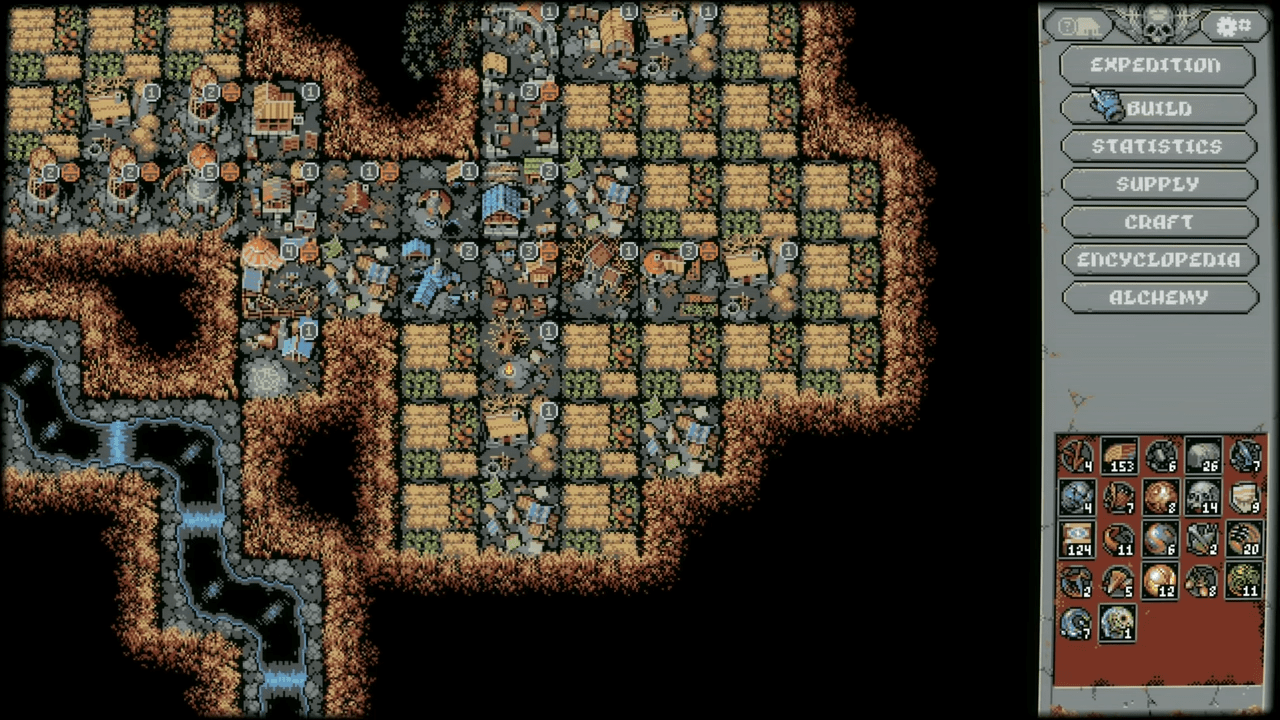
Pro Tip: Build the Herbalist Hut early because it gives you more healing consumables to help survive tougher loops.
6. Boss Triggers and Fight Strategies
Each chapter ends with a boss that appears once the boss meter fills. Boss health and behavior may be modified by active map tiles (e.g. Lich Palaces) and your current stats and gear. To succeed, manage the number and type of spawned enemies before triggering the boss, and enter the fight with optimized gear and consumables.

- Meter Management: Placing tiles increases the boss bar and removing tiles via Oblivion reduces it. You can delay summoning by holding off on placements until you’re ready.
- Fight Prep: Clear or remove high threat tiles near the map exit, equip single target or tank gear (high HP/defense, vampirism, regeneration), and make sure buffs and healing sources (e.g. Meadows, vampirism items) are active.
- Targeted Counters: Use class mechanics to counter boss traits: Necromancer can use minions to absorb aggro, Rogue can deliver burst damage during vulnerable windows, and Warrior’s defense or shield mechanics help endure strong hits. Adapt your approach using boss pattern knowledge (e.g. focus adds first, disrupt phases)

Boss Tip: For The Lich, the Lich’s Palace tiles that spawn around your campfire each increase his HP and damage by 5 % each, so destroy as many of those palace tiles as possible before the fight.
7. Practical Loop Route and Risk Management
Risk management is the single most important survival skill in Loop Hero. Successful runs balance resource collection with a controllable spawn rate. Do not overfill the map with heavy spawn tiles early. Create controlled clusters that grant resources while keeping enemy waves manageable.

- Start with defensive tiles that scale survivability, such as Meadow and Mountains. Mountains can combine into mountain peaks that raise maximum health but may also produce tougher enemies.
- Add moderate enemy spawns, such as Village and Vampire Mansion, only once your gear and healing can handle extra waves. Avoid placing several heavy spawn tiles next to each other early in the run. Tile transformations can become stronger over time and sometimes do not revert when you remove the original tile.
- Monitor the boss meter and delay the boss by holding off on placements when needed. Use Oblivion to remove tiles and roll back the boss meter slightly, but be careful: playing Oblivion still counts as a card action and can summon the boss if it was the final placement.
- Retreat after securing key resources or when the boss appears and you are unprepared. Retreating from the campfire tile preserves your resources. Retreating elsewhere typically causes a resource loss of about 40%. Dying usually costs a larger share of resources, commonly around seventy percent.

Practical Tip: Keep an eye on your camp unlock goals each run; if you are one resource away from a pivotal building, tailor the loop to collect that resource then retreat rather than chasing one more risky fight.
8. Advanced Tips, Secrets, and Hidden Bosses
Here are some advanced strategies and secret mechanics in Loop Hero that skilled players use to push runs further and unlock hidden content:

- Prioritize non-obvious stats over raw levels. A higher-level item is not always better. For example, if a rare ring grants “+1 Skeleton” or “+% vampirism” and that better fits your build, it may outperform a higher-level item with weaker or irrelevant bonuses.
- Delay the boss until you’re ready. Avoid placing every card you draw. Sometimes not placing cards (or using Oblivion to remove risky ones) helps push the boss trigger later, giving more room to farm resources and upgrades.
- Use tile synergies carefully. Many tiles combine or evolve when adjacent to certain types (e.g. Meadows + Mountains can produce Blooming Meadows). But some combinations also increase spawn pressure. Always test or anticipate behavior.
- Watch for hidden boss triggers. Loop Hero has secret bosses beyond the standard chapter bosses:
• To unlock the Dimension Rift, you must stack multiple area-of-effect tiles (e.g. Vampire Mansion, Battlefield, Beacon, Chrono Crystal, Bookery) so that their AoEs overlap. When blue wisps appear from the overlapping tile, use Oblivion on it to spawn the Rift.
• Defeating the Dimension Rift leads to a fight with the “True Creators” (the devs) as secret bosses.
• Another hidden boss is the Frog King, which has its own summoning requirements in swampy or wet terrain setups. - Camping layout and supply slots matter in secret boss fights. For the “True Creators” fight, some dev-fight mechanics depend on the number of empty supply slots or how many camp tiles are filled, so building + layout choices made before the fight may influence difficulty.
- Be cautious with Ruins. Ruin tiles may spawn worms that attack from two tiles away (skipping adjacency), making boss fights much harder if you place Ruins too close to the camp fire or near expected boss spawn paths.
- Exploit rivers for multipliers. River tiles double the effect of adjacent stat-boosting tiles, and double stacking (two rivers adjacent) compounds the bonus. Use them to amplify effects of Meadows, Mountains, etc.

Quick checklist before a big fight
- Check boss meter level, hold placements if meter is high.
- Equip the best single target weapon and survivability items.
- Activate meadow or steady healing sources.
- Remove or isolate nearby heavy spawn tiles with Oblivion.
- If unsure, retreat from the camp tile and come back stronger.

Advanced Reminder: Attempt hidden bosses and dimension rift setups only after you understand tile areas of effect and have strong backups. These fights can be unpredictable but yield unique rewards.
9. Conclusion

By mastering tile synergies, pacing your boss triggers, optimizing your builds, and managing risk, you’ll push considerably further in Loop Hero than most casual play allows. The game rewards patience, flexibility, and the willingness to adapt to surprises. And once you’ve beaten the standard chapters, the hidden bosses and secret encounters await to test your understanding of every core mechanic. Use this guide as your framework, but experiment, iterate, and discover your own loop-mastering style.



Customer Reviews
Thanks for submitting your comment!