
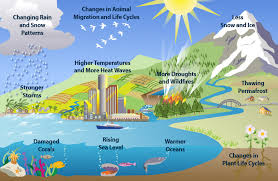
Individuals all over the planet are encountering emotional heatwaves, lethal floods, and fierce blazes because of environmental change.
The UK and portions of Europe have seen temperatures above 40C this month, prompting transport interruption and water deficiencies.
Emanations brought about by the consumption of petroleum derivatives have been catching intensity in the air starting from the beginning of modern times. This additional intensity isn’t equally conveyed across the globe, and blasts out outrageous climate occasions.
Except if worldwide outflows are cut, this cycle will proceed.
The following are four different ways environmental change is changing the climate.
- More blazing, longer heatwaves
To comprehend the effect of little changes to average temperatures, consider them a chime bend with outrageous cold and hot at one or the flip side, and the main part of temperatures in the center.
A little change in the middle means a greater amount of the bend contacts the limits – thus heatwaves become more continuous and outrageous.
Temperatures in the UK beat 40C interestingly on 19 July.
The Met Office assesses that the outrageous intensity seen during the latest heatwave is multiple times more probable now in light of environmental change. Furthermore, things could deteriorate.
“In years and years this could really be a seriously cool summer,” says Professor Friederike Otto, an environment researcher at Imperial College London.
The Met Office has likewise brought up that heatwaves are not simply more sultry: They’re additionally enduring longer. Warm spells have dramatically increased long in the beyond 50 years.
For what reason is it so hot in the UK?
Is the UK getting more sweltering?
Heatwaves can be made longer and more extreme by another climate peculiarity – an intensity vault.
In a space of high strain, hot air is pushed down and caught set up, making temperatures rise above a whole mainland.
At the point when a tempest contorts the fly stream, which is made of ebbs and flows of quick streaming air, it is a piece like yanking a jumping rope toward one side and seeing the waves move along it.
These waves make everything slow radically and climate frameworks can become stuck over similar regions for a really long time – as was found in India recently.
India and Pakistan have previously confronted five progressive heatwaves this year, with Jacobabad, in Pakistan, enrolling 49C at one point in May.
In the Southern Hemisphere, Argentina, Uruguay, Paraguay and Brazil all saw a notable heatwave in January – numerous regions revealed their most blazing day on record.
Around the same time, Onslow in Western Australia hit 50.7C, the joint-most noteworthy temperature at any point dependably kept in the Southern Hemisphere.
Last year, North America was likewise hit by lengthy heatwaves. The western Canadian town of Lytton torched when temperatures hit 49.6C, breaking the past record by practically 5C.
Such an extraordinary heatwave would have been practically unimaginable without environmental change, says the World Weather Attribution organization, a coordinated effort between global environment researchers.
One hypothesis proposes higher temperatures in the Arctic are making the fly stream slow, improving the probability of intensity arches.
Life at 50 degrees
- More diligent dry spells
As heatwaves become more extraordinary and longer, dry spells can likewise deteriorate.
Less downpour falls between heatwaves, so ground dampness and water supplies dry up more rapidly. This implies the ground requires some investment to warm up, warming the air above and prompting more extreme intensity.
Dry spell in Somalia – the nation has experienced three bombed blustery seasons in succession
Interest for water from people and cultivating puts much more weight on water supply, adding to deficiencies.
- More fuel for rapidly spreading fires
Rapidly spreading fires can be ignited by direct human contribution – however normal variables can likewise have an enormous influence.
The pattern of outrageous and dependable intensity brought about by environmental change coaxes increasingly more dampness out of the ground and vegetation.
These kindling dry circumstances give fuel to flames, which can spread at an extraordinary speed.
Most as of late extreme fierce blazes have been accounted for in France, Spain, Portugal, Greece, Croatia and Albania – with large number of occupants cleared and a few hundreds answered to have kicked the bucket.
In Canada the previous summer, heatwaves prompted fires which grew so quickly and dangerously that they made their own climate framework, shaping pyrocumulonimbus mists. These enormous mists then, at that point, delivered lightning, touching off additional flames.
The recurrence of enormous fierce blazes has expanded decisively in late many years.
Contrasted and the 1970s, fires bigger than 10,000 sections of land (40 sq km) are presently multiple times more normal in western America, as per Climate Central, an autonomous association of researchers and columnists.
- More outrageous precipitation occasions
In the standard weather conditions cycle, sweltering weather conditions makes dampness and water fume in the air, which transforms into beads to make downpour.
A graph showing how record temperatures cause outrageous precipitation. 1) More intensity from sun causes more prominent dissipation 2) More dampness structures mists 3) Heavier downpour
The hotter it turns out to be, in any case, the more fume there is in the climate. This outcomes in additional beads and heavier precipitation, some of the time in a more limited space of time and over a more modest region.
Currently this year, floods have hit Spain and furthermore parts of eastern Australia. In a time of only six days Brisbane saw practically 80% of its yearly precipitation, while Sydney kept more than its normal yearly precipitation in minimal north of 90 days.
These precipitation occasions are associated with the impacts of environmental change somewhere else, as per Peter Gleick, a water expert from the US National Academy of Sciences.
“At the point when areas of dry season develop, as in Siberia and western US, that water falls somewhere else, in a more modest region, demolishing flooding,” he says.
The climate across the globe will constantly be profoundly factor – however environmental change is making those varieties more limit.
What’s more, the test presently isn’t just restricting the further effect individuals have on the environment yet in addition adjusting to and handling the limits we are now confronting.
BBC Weather


Customer Reviews
Thanks for submitting your comment!