
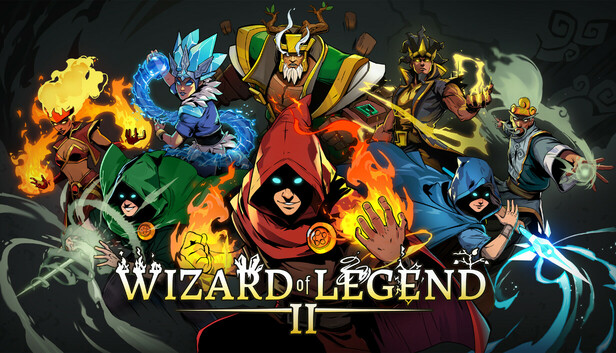
1. Game Overview
Wizard of Legend is a fast-paced roguelike dungeon crawler where you play as a wizard trying to prove your mastery by completing the Chaos Trials. You fight through procedurally generated levels, collecting spell combinations (called arcana), relics and outfits to build your power. Along the way, you face element-themed bosses and eventually a final showdown with the most powerful wizard.

- Developer: Contingent99
- Publisher: Humble Games
- Engine: Unity
- Release Dates: May 15, 2018 (PC, consoles), October 27, 2023 (Android & iOS)
- Platforms: Windows, macOS, Linux; PS4; Xbox One/Series X|S; Nintendo Switch; iOS/Android (Netflix)
- Genre: Roguelite dungeon crawler, real-time combat
- Core Loop: Choose or build a wizard loadout → enter the Chaos Trials → fight through randomly generated floors → collect new arcana (spells), relics, upgrades → face major bosses → either win or die → unlock new options for future runs

2. Story & Chaos Trials
Every year in the fantasy Kingdom of Lanova, the powerful Council of Magic organizes the Chaos Trials, a magical competition designed to test the mettle of aspiring wizards. Contestants who can overcome rooms full of conjured enemies, overcome elemental-majored challenges, and defeat the council’s champions earn the prestigious title Wizard of Legend. The Trials take place in a magically mutable labyrinth, shifting with each participant’s run, where magic is drawn from elemental powers and arcane relics to shape both obstacles and combat.

Setting: Magical castle with themed chambers shaped by elemental Council members, not exactly “rotating floors.”
Objective:
- Clear three randomly ordered elemental sections (Water, Fire, Air/Wind, Lightning, or Earth) each composed of multiple stages.
- In each section, defeat a Council Member tied to that element.
- After the three elemental Council Members are defeated, enter the final boss chamber.
- Defeat Master Sura (the Head Councilor) to claim the title Wizard of Legend.

Replayability: RNG is used for chamber/room composition, the order of elemental sections, shops, arcana/relic drops etc., which ensures each run feels fresh
3. Core Mechanics & Combat Systems
Combat emphasizes speed, positioning, and crowd control. Players must dodge, stun, or manipulate enemies rather than rely on raw defensive stats or invulnerability by default.

- Dash Movement: Players can perform a dash (short blink or movement burst) via input; this dash does not grant invulnerability frames (i-frames) unless a specific relic (e.g. Leemo’s Leaf) or arcana grants them.
- Signature Arcana & Meter: A signature arcana is a powerful ability that must be charged by dealing damage; once the meter is full, using the signature grants enhanced effects.
- Environmental Hazards: Traps such as spikes or pits, and certain stage hazards, can damage both players and enemies; players can use them strategically.

Pro Tip: Try to conserve health orbs throughout the elemental stages so you enter the final boss fight with as much health as possible. Any additional hit you survive can give you a better margin in the Head Councilor battle
4. Arcana Elements & Spell Types
Arcana are spells you equip each run. You select one each of the four types: Basic, Dash, Standard, and Signature. Arcana span six elements: Fire, Water, Earth, Air, Lightning, and Chaos. Chaos arcana are rare and generally only obtained by defeating the final Council member.

Spell Types:
- Basic Arcana: Fast, low damage, low cooldown spells used frequently and to build up other resources or manage weaker enemies.
- Dash Arcana: Activated during a dash to enhance mobility and often to deal extra damage or trigger effects while moving.
- Standard Arcana: More powerful than basics, with moderate cooldowns and effects; useful for area control, crowd management, or damage.
- Signature Arcana: High-impact arcana that consume the signature meter when used; they are often enhanced and deal significantly more powerful or special effects when the meter is full.

5. Relics & Loadout Planning
Relics provide passive bonuses and occasionally special effects like extra resistances or defensive utility. You can equip multiple relics per run, which are found in chests, dropped by enemies, or bought in shops, and some relics are permanently unlocked in the plaza using Chaos Gems. The game supports “fusion relics,” which combine two relics into a more powerful relic with enhanced effects

- Acquisition: Found in chests, dropped by enemies, or sold in shops during the Trials; also purchasable permanently in the plaza with Chaos Gems
- Selection: You should pick relics that enhance your chosen arcana or build, e.g. relics that reduce cooldowns, boost elemental damage, provide defensive utility, etc.
- Merge System: A relic grouping system was added in updates (e.g. v1.23) so that similar relics are grouped or merged in the UI to save inventory space

Tip: Chain Basic → Dash → Signature in tight enemy clusters when possible to quickly build your signature meter and capitalize on arcana or relics that stun or disable enemies
6. Dungeon Flow & Shops
Each run of the Chaos Trials contains three elemental stages, each made up of two regular floors plus a boss floor, followed by the final boss stage. Shops appear on non-boss floors in those elemental stages, and there is also a shop just before the final boss. Managing your gold, health (or healing), and Chaos Gems is important, because Chaos Gems are a meta-currency used outside the Trials for permanent unlocks.

- Chamber Rewards: Clearing rooms gives you gold, health orbs (or potions via shops/NPCs), and sometimes Chaos Gems. Chests may yield rewards; some rooms spawn mimic-chests
- Shop Types & Locations: Shops offer arcana, relics, health potions, and outfit upgrades. Regular shops show up between regular floors, but not in boss floors (except pre-boss stage). NPC shops vary by type (arcana shop, relic shop, random NPC shops with side effects).
- Resource Prioritization: It is often advisable to spend on health or healing options early if you’re low on survivability. Upgrading arcana cooldowns or acquiring strong relics becomes more important as you progress, especially before boss fights.

7. Advanced Strategies & Pro Tips
Here are some advanced strategies & pro tips to help you push further in Wizard of Legend and improve your run consistency:

- Prioritize multi-hit/multi-strike arcana like Bolt Rail or Shock Assault to synergize with relics that scale on hits, which helps both damage output and survivability via healing-on-crit or health-on-hit relics.
- Use AoE and crowd control arcana (like rings, delayed AoE bursts, or stun/freezing effects) to manage groups of enemies early before they overwhelm you; delaying group control often causes more damage than bosses.
- Become familiar with miniboss attack patterns, especially their stunnable windows and invulnerability phases, then use arcana or relics that amplify your ability to punish those windows.
- Invest early in relics that enhance survivability (life leech, health orb drops, evasion, or cooldown reduction) especially during early floors, because staying alive to later stages gives more options and stronger rewards.
- Build around a theme or element when possible so that you can stack bonuses more reliably (elemental enhancements, matching arcana + relic effects), rather than scattering different elements which may dilute synergies.

8. Conclusion
To sum up, Wizard of Legend rewards players who understand its core systems: the interplay of arcana, relics, signature mechanics, and stage flow. Using the pro tips here, such as chaining attacks, saving health, and choosing relics and spells that synergize, you’ll see marked improvement in your success rate. Keep refining your builds, learning what works best for your style, and you’ll find the difference between average runs and becoming a true Wizard of Legend

Customer Reviews
Thanks for submitting your comment!