

1. Game Overview
In Hand of Doom you play as an apprentice wizard bound by a blood contract to serve a powerful sorcerer while travelling between planes to confront Doomlords who threaten the very fabric of reality. The game blends dungeon-crawling, puzzle solving, and spellcasting with an old-school aesthetic that leans heavily on FMV and surreal environments. You can choose to slay or befriend powerful entities as each decision influences how the story unfolds

- Developer: Torple Dook
- Publisher: DreadXP
- Release Dates: May 16, 2023
- Platforms: Microsoft Windows (Steam)
- Genre: Adventure, RPG with FMV, dungeon crawler elements
- Core Loop: Learn new incantations → explore planar realms → confront/Doomlords via puzzles or combat → choose to slay or befriend → unlock more spells & regions → repeat.

Quick Fact: Hand of Doom supports 18 Steam achievements.
2. Core Systems + Known Issues
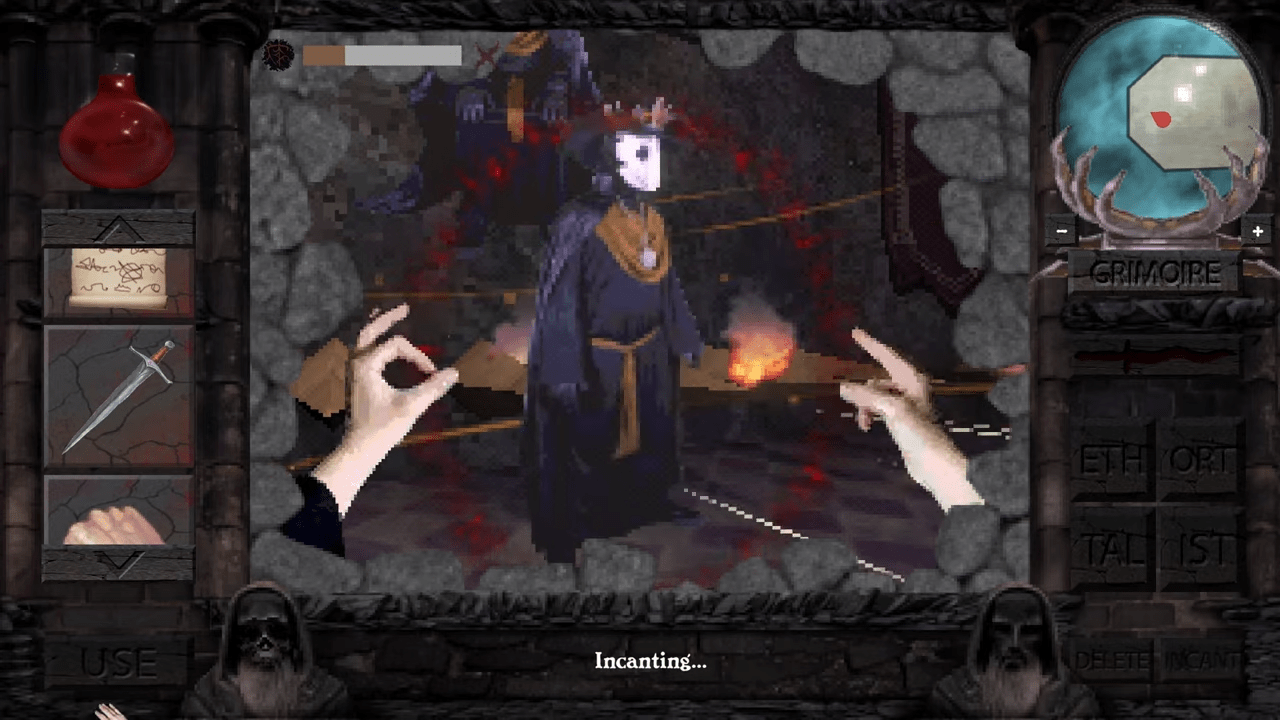
The following table outlines the main gameplay systems in Hand of Doom and how they meaningfully impact the player experience. It also pulls together recurring bugs, frustrations, and design caveats reported by users and reviewers that affect progression, immersion, or usability. By comparing the systems side-by-side with known issues you’ll get a clearer sense of both what the game aims to do well and where those ambitions stumble in practice.
| System | What It Does | Player Impact | Known Issues |
|---|---|---|---|
| Spellcasting and Incantations | Learn spells via incantation combos to cast in combat and solve puzzles | Unlocking spells is essential; mastery enables progress. | Soft-locks if you enter areas before learning needed spells (e.g. entering elemental planes without “Rain”) |
| Exploration and Environmental Puzzles | First-person traversal through surreal planes, gathering runes/reagents, using spells to clear obstacles | Rewards include new spells, lore, puzzle cues; exploration opens new paths. | Large levels lead to tedious walking/backtracking; some triggers fail to fire |
| Choices & Consequences | Decisions to slay or befriend entities; story branches | Influences story outcomes, spell access, allies. | Some quest logs do not update correctly; outcomes can be blocked by earlier choices |
| FMV and Presentation | Uses live-action style, retro visuals, theatrical dialogues, atmospheric design | Enhances immersion; gives flavor; clues sometimes in style. | Audio mixing inconsistent; some FMV or scenes fail to trigger |
| Save and Progress System | Autosave at checkpoints; limited manual control | Mistakes are more costly; careful decision timing matters | Only one save slot; soft-locks can force full restart. |
| Combat and Encounter Mechanics | Combat uses sword mechanics, spells; boss fights exist. | Combat provides challenge and breaks up puzzle gameplay. | Some feel combat is shallow: spells often less effective than melee attacks; boss fights or final area may “bug out” |

3. Spellcasting, Runes, and Puzzle Mechanics
Players learn spells and cast them by performing incantations (via words or syllables) and using reagents. Spells are central to both combat and solving environmental puzzle

- Learning methods: Spells are discovered through exploration, reading in-game texts, performing quests, or by observing cues from FMV sequences and environments.
- Casting input and precision: Success depends on correctly entering incantations; the order or phrasing matters for spells to work properly.
- Puzzle integration: Many environmental puzzles require specific spell effects (such as freezing, fire, elemental interaction) to open paths, reveal hidden items, or progress.

Practical Rule: When crossing lava zones in the fire plane, we suggest strafing + moving forward quickly. You’ll survive with minimal health, but reach the next checkpoint.
4. Combat, Encounters, and Choices
Combat mixes spell duels, environmental hazards, and direct clashes. Many major encounters with bound entities let players choose between fighting, nonviolent approaches, or ritual-like resolutions which influence what comes next.

- Encounter Flow: Players must pick spells carefully and manage finite reagents; some Doomlord or major fights allow multiple ways to succeed.
- Resource Management: Reagents and other spell components are limited per playthrough; high-tier resources are best saved for key encounters.
- Alternate Resolutions: Some encounters let players befriend or bind entities instead of killing them. Choosing these routes can unlock special allies or spells and shift narrative outcomes or endings.

Combat Tip: Before major encounters, verify that your required slots of reagents and incantation components are stocked. Certain high-tier spells are only usable if components remain.
5. Progression, Quests, and Endings
Progression
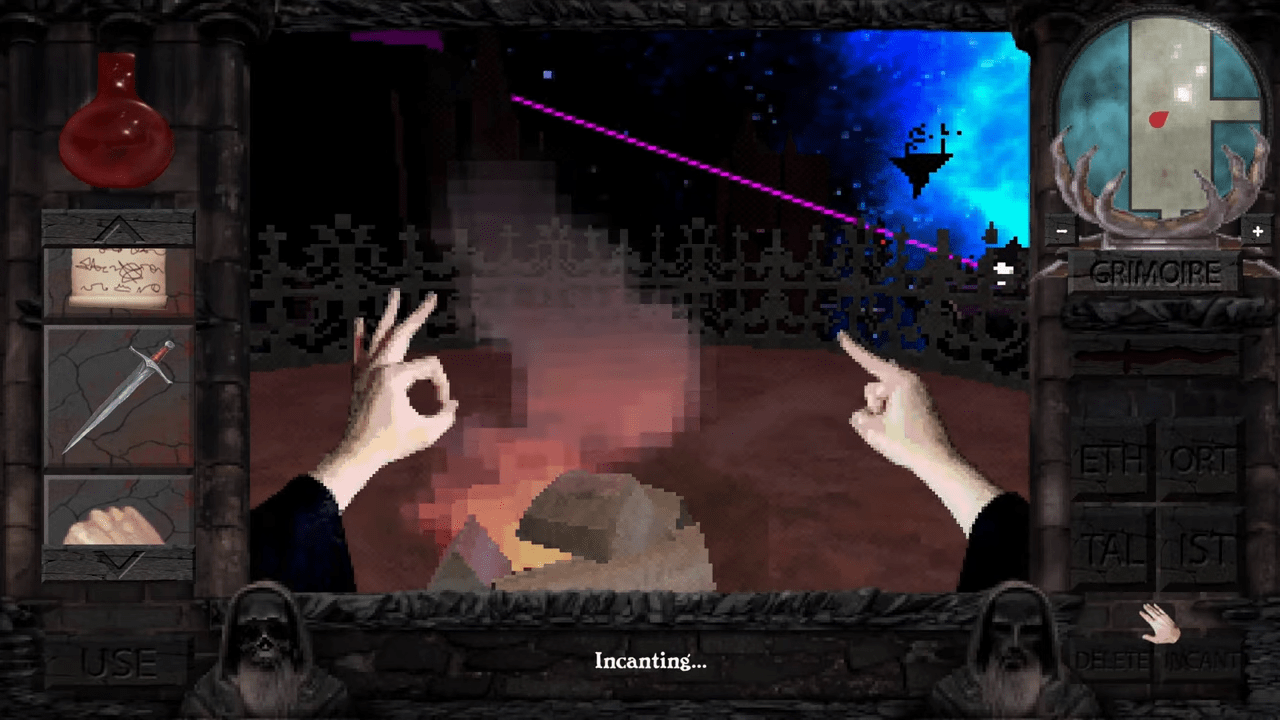
- The game advances by discovering spells, performing incantations, exploring new areas, and solving puzzles. Each new spell or ability tends to unlock environmental or narrative access.
- Players gain resources (reagents, spell components) along the way, which are finite and make resource management relevant to progression. Running out of needed reagents before a fight or puzzle can block or slow progress.
- The game features “grimoire” or spellbook-like tracking of spells once learned. Some spells can be added simply by casting them, not always by finding a text or quest.
Quests

- There are a variety of quest-like objectives: lore exploration, finding items, solving environmental puzzles, interacting via dialogue, and engaging in encounters with bound entities. Many of these tie into spell learning or unlocks.
- Quests are not always formal in the sense of “go here, kill this,” etc.; many emerge organically via exploration or through observing the world (FMV, texts, items).
- Some quests or quest-like interactions provide different possible resolutions based on choices made (violent vs non-violent, sparing vs killing, etc.), which feed into endings.
Endings

- Hand of Doom does offer multiple endings. Decisions made during certain encounters (e.g. whether to spare or kill, how you resolve major conflicts) affect the ending you get.
- Some endings are worse or better depending on how many positive choices the player made. For instance, saving trees or sparing bosses vs the opposite can change the final outcome or player’s narration at the end.
- However, the magnitude of difference between endings may be more about flavor, epilogue text, or tone rather than entirely different final scenes or drastically different gameplay post-ending. Replay value is moderate but not assuredly large.
6. Practical Strategies and Advanced Tips
A few critical practices can make the difference between a smooth run and a frustrating dead end. Though the game encourages experimentation, several softlocks and branching decision points have tripped up players. The six strategies below target areas most likely to block your progress or limit your options, so use them as guardrails to keep your run viable while still exploring freely

- Learn the Rain spell before entering fire-plane areas
Because lacking that spell can soft-lock your progress when an objective requires extinguishing fire. - Avoid leaving an area mid-quest or mid-checkpoint in “orb” objectives
Destroying ice orbs but quitting before finishing the objective sometimes causes the game to “forget” those orbs, preventing progress. - Use external save backups if possible
The Steam community explicitly suggest copying save files so you can revert to a point before a soft-lock or game bug. - Prioritize obtaining defensive and traversal spells early
Spells like Fire Shield or ones that mitigate terrain hazards help avoid health loss or being trapped, especially in elemental planes. - Memorize or keep a reference for incantation syllables
Since spell casting depends on correctly inputting the right sequence, knowing which syllables combine for useful spells (e.g. TAL, ETH, ORT) saves trial/error and reduces risk in critical moments. - Choose “befriending” or nonviolent options carefully when offered
Because some endings, rewards, or narrative branches depend on whether you slay, bind, or spare entities; making the alternative choice can unlock unique content.

Accessibly Tip: The game may apply an incorrect resolution when your monitor supports multiple refresh rates for a 16:9 resolution.
7. Conclusion

With the right approach, Hand of Doom unfolds less like a trap-filled maze and more like a rich, reactive world. Armed with the insights in this guide, you can cast confidently, explore without fear of dead ends, and make choices that feel deliberate rather than regrettable. Let curiosity lead, but let preparation protect, so your wizard’s story ends on your terms rather than in frustration.
Customer Reviews
Thanks for submitting your comment!